Outdoor lighting can completely change how a space looks and functions after dark. But not all outdoor lighting is designed to do the same job.
Landscape lighting and pathway lighting are sometimes used interchangeably, but they serve different primary purposes. For developers and municipalities planning parks, trails, plazas, walkways and other public spaces, understanding that difference can help ensure the right light is used in the right place.
What Is Landscape Lighting?
Landscape lighting is primarily used to enhance the appearance of an outdoor environment.
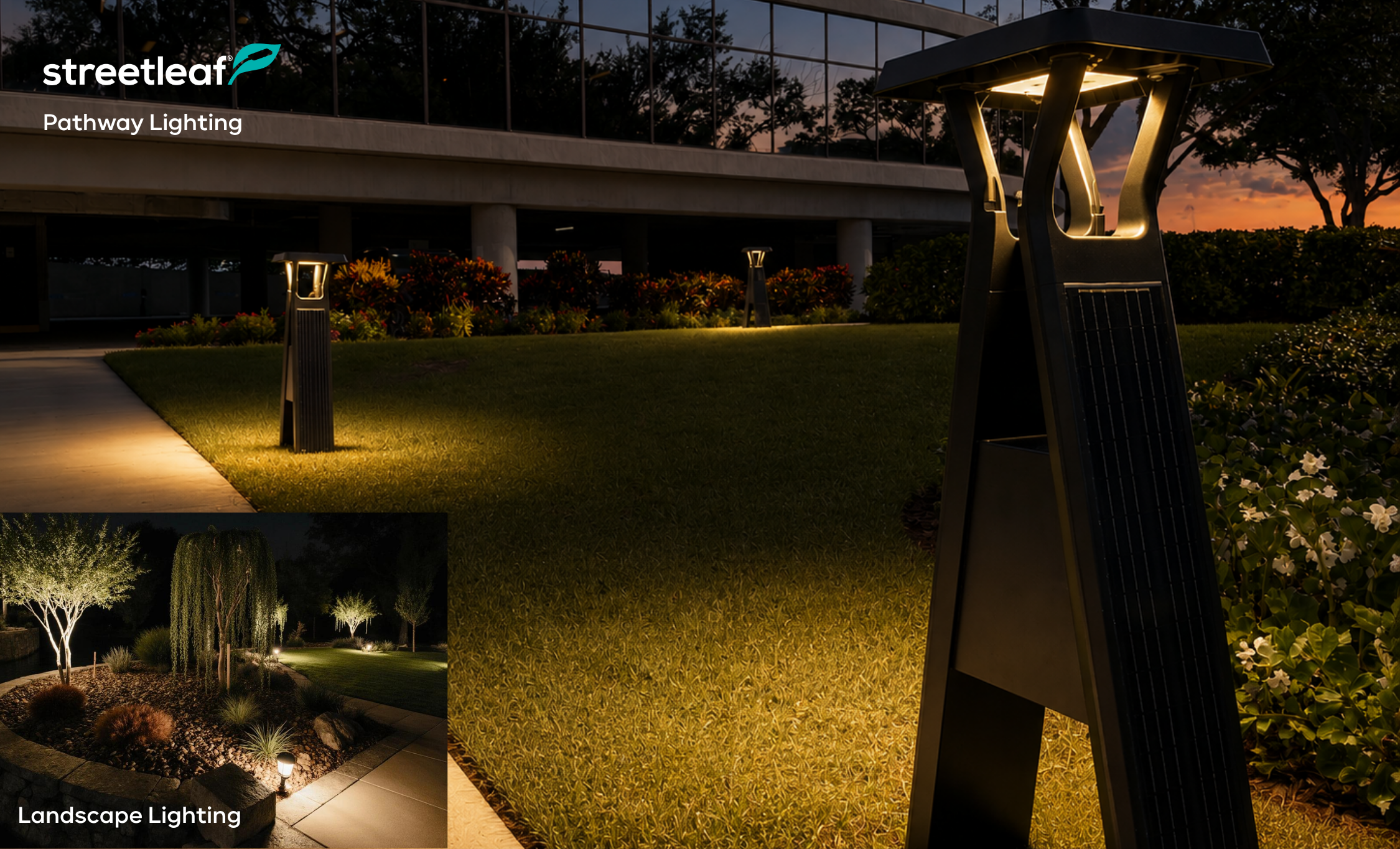
Think about the small fixtures used to illuminate trees, architectural features, gardens, signs or other landscape elements. Uplights, spotlights, accent lights and small path lights can all be part of a landscape lighting design. The goal is often visual: create depth, highlight an architectural or landscape feature, establish ambiance or make an outdoor environment more inviting after dark.
Traditional landscape lighting systems are also commonly low-voltage systems, which means fixtures may need to be connected by underground wiring to a transformer and electrical power source.
While landscape lighting can certainly improve visibility, pedestrian illumination is not necessarily its primary purpose.
What Is Pathway Lighting?
Pathway lighting starts with a different question: Where do people need light to comfortably navigate this space after dark?
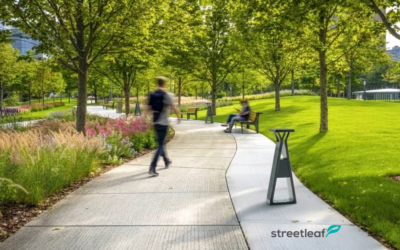
It is designed to illuminate pedestrian environments such as walkways, trails, parks, plazas, building perimeters, commercial landscapes, parking areas, and pedestrian connections. Bollards are commonly used for this purpose because their low mounting height places illumination closer to the pedestrian environment.
Unlike a small accent light intended to highlight a tree or planting bed, pathway lighting is selected and positioned to provide usable illumination across the areas where people are actually walking.
That makes factors such as light distribution, fixture spacing, mounting height and glare control especially important.
Light Distribution Makes a Difference
Lumens tell you how much light a fixture produces. They don’t tell you where that light goes. That distinction matters.
Outdoor luminaires can use different optical distributions to direct light toward specific areas. A narrow pathway, for example, may require a different distribution than an open plaza. Streetleaf PATH uses a Type V distribution, which distributes light evenly around the fixture. Its integrated LED lighthead produces 600 lumens of warm 2700K illumination.
That combination makes Streetleaf PATH well suited for pedestrian spaces where low-level illumination is needed around the bollard, rather than simply highlighting a nearby landscape feature.
Where Streetleaf PATH Fits
At approximately 42 inches tall, Streetleaf PATH has the architectural appearance of a landscape bollard, but it is designed as a pathway lighting solution. That distinction is intentional.
Streetleaf PATH brings Streetleaf’s fully off-grid solar technology down to the pedestrian level, providing dedicated illumination for walkways, trails, parks, plazas and other spaces where a traditional streetlight may not be the right fit. Its tri-panel solar array captures solar energy from three directions, while an integrated LiFePO₄ battery provides four days of reserve capacity.
And because Streetleaf PATH is fully off-grid, there is no need to trench across a site to run electrical wiring to each fixture.
Pathway Lighting Without the Wiring
For developers and municipalities, adding lighting to an existing pedestrian area can create a practical challenge. Traditional wired lighting may require trenching, conduit, electrical connections and restoration of disturbed areas. Those requirements can become especially complicated around finished landscapes and existing hardscapes.
Streetleaf PATH eliminates the electrical connection entirely.
Each bollard operates independently using its integrated solar panels, battery and LED lighthead. Streetleaf PATH ships fully assembled and can be mounted to an appropriate hard, flat surface, including concrete. That makes it an option for both new developments and existing pedestrian environments where adding wired lighting may be disruptive or impractical.
The Right Light for the Right Space
Landscape lighting and pathway lighting can work together beautifully, but they don’t always have the same job. Landscape lighting can draw attention to the places you want people to see. Pathway lighting helps illuminate the places you want people to go.
For developers and municipalities, that distinction matters when planning outdoor environments that need to be attractive during the day and comfortably navigable after dark.
Streetleaf PATH was designed for exactly those spaces, combining purposeful pedestrian illumination with a modern architectural form and fully off-grid solar power.
Meet Streetleaf PATH and reserve yours today. https://streetleaf.com/reserve-streetleaf-path/