Technology advances have made solar streetlights more dependable. Long-term service is what keeps them that way.
Solar streetlighting has come a long way. Advances in battery technology, LED efficiency, and system design have made modern solar streetlights a dependable option for builders, developers, municipalities, and utilities in a growing range of applications.
A streetlight is also a long-term piece of community infrastructure, and how it performs over decades depends as much on service as it does on hardware. Design, monitoring, and maintenance determine whether solar streetlighting delivers dependable light year after year or becomes a recurring problem.
The most important advancement goes beyond the hardware. It is the ability to deliver dependable lighting backed by experienced design, service, and support.
Why Service Became the Deciding Factor for Solar Streetlights
Streetleaf CEO Liam Ryan often describes a county-maintained parking lot in South Florida that was lit entirely by solar and battery-powered lights. On paper, it was a showcase project. In practice, the maintenance crew was replacing lead-acid batteries every two years, and whatever savings had been expected were long gone.
That experience was common in the early years of solar lighting. Many systems were sized for a sunny day rather than the worst week of winter, used batteries that wore out quickly, and were sold by companies that were no longer around when those batteries failed. The lesson for the industry was clear. A solar streetlight is only as reliable as the design, components, and support behind it.
Long-Term Service Starts With Photometric Design
Reliable performance begins before a single pole is installed. Photometric design determines how much light each fixture needs to deliver, where poles should be placed, and how the solar panel and battery should be sized for the site.
Modern lithium iron phosphate batteries, high-efficiency LEDs, and properly sized solar panels allow each light to store energy and keep operating through consecutive days of limited sun. The key is designing every system for real-world conditions, including seasonal changes, shorter winter days, and local weather patterns.
Getting that design right has a direct effect on maintenance later. A system sized for real-world conditions puts less strain on its battery, maintains consistent light levels, and is less likely to need corrective work in its early years of service.
How Remote Monitoring Supports Solar Streetlight Maintenance
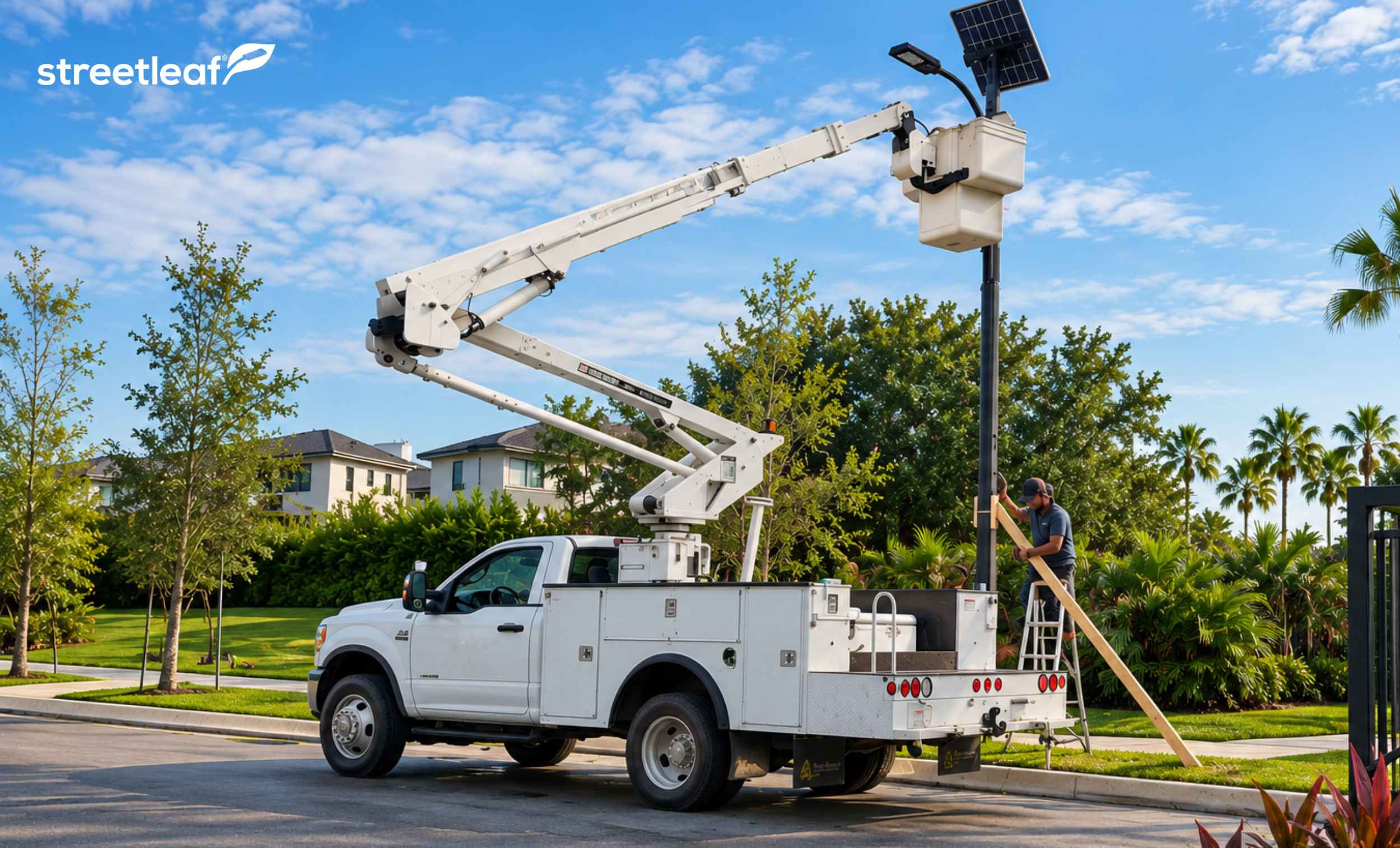
Traditional streetlight outages are often discovered when a resident reports a dark street. Remote monitoring changes that approach. Streetleaf’s turnkey service includes photometric design, installation, 24/7 remote monitoring, and proactive maintenance, so the performance of each light is tracked continuously and outages can be flagged as they happen.
That visibility allows maintenance to be proactive rather than reactive. Issues can be identified and scheduled for repair before they become a pattern, and monitoring data helps confirm that each light is performing as designed across seasons. For community managers and public works teams, it also means fewer surprises and better information for planning.
Why Long-Term Maintenance Matters as Much as Installation
The value of streetlighting is not determined by installation cost alone. Communities also need to consider the ongoing cost of operating, maintaining, and repairing lighting over its full service life. Batteries, electronics, and LEDs all have service lives, and a responsible maintenance plan accounts for them from the start. Today’s lithium iron phosphate batteries last several times longer than the lead-acid batteries used in early systems, which makes planned replacement far more manageable than it once was.
Service matters most when conditions are at their worst. During Hurricanes Helene and Milton in 2024, Streetleaf documented a 99.61% reliability rate across 1,129 solar streetlights in the path of the storms. After each storm, the Streetleaf team drove its installation sites to check performance and respond to any issues. In many neighborhoods, homes were dark while utility crews worked to restore power, yet the Streetleaf streetlights stayed on.
Choosing a Solar Streetlight Service Model
Different projects call for different levels of support. Some owners have their own maintenance teams and prefer to purchase lights directly, adding monitoring or service as needed. Others prefer a service agreement in which installation, monitoring, and maintenance are handled by the provider for a predictable monthly fee. The best fit depends on budget structure, internal resources, and long-term ownership plans.
Whatever the model, a few questions help clarify what long-term service will look like. How long has the provider been designing, installing, and maintaining systems, and at what scale? How are lights monitored, and how quickly are issues addressed? Who is responsible for planned component replacement, and what warranty applies? The answers say as much about a solar streetlight as its specifications.
Where Solar Streetlighting Fits Today
Solar streetlighting has moved beyond its early limitations, but technology alone does not guarantee results. Long-term performance comes from thoughtful design, continuous monitoring, planned maintenance, and a team that stays involved after installation. That durability is part of the sustainability story as well. Across more than 6,000 installations, Streetleaf lights have reduced more than 7 million pounds of carbon emissions, and well-maintained systems keep delivering that value for years. For many communities, the question is no longer whether solar streetlighting deserves consideration, but how to evaluate it over the full life of the system.
Ready to Rethink Streetlighting for Your Next Project?
Whether you’re planning a new community or evaluating lighting upgrades, Streetleaf can help you explore where fully off-grid solar streetlighting makes sense. From photometric design to installation and long-term service, our team is here to help you find the right solution.